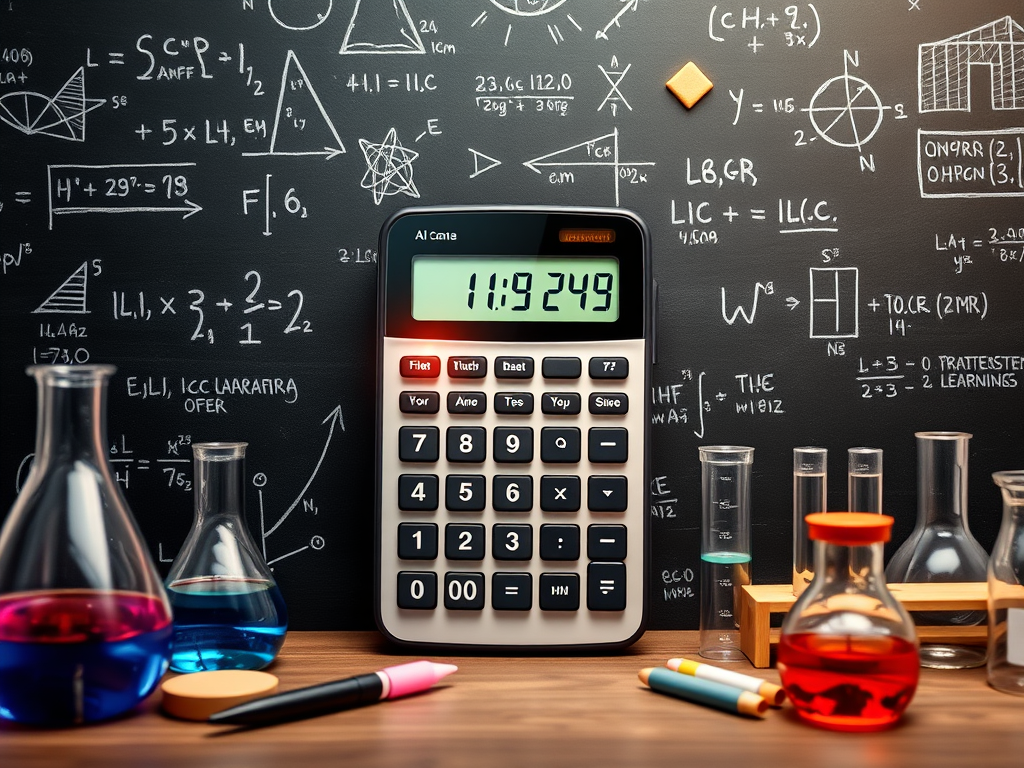
The Evolution of Calculators with Artificial Intelligence
In the ever-evolving landscape of education, technology plays a vital role in enhancing the learning experience. For science students, mastering complex calculations is an essential skill, one that can often be daunting without the right tools. This is where artificial intelligence can make a significant impact, bringing forth a new generation of calculators that are not just functional but intelligently adaptive to the needs of learners.
Understanding the Basics
At its core, a calculator is a device that calculates, right? But with AI, these devices have begun to do much more—they analyze, predict, and sometimes teach. So, what exactly sets an AI-enhanced calculator apart from its traditional counterpart?
The Integration of AI and Machine Learning
Artificial Intelligence and Machine Learning are the buzzwords today, but their integration into calculators is not just a gimmick. AI-powered devices can learn from a user’s input, adapt to their style, and provide recommendations based on past usage. This can significantly ease the process of learning complex mathematical and scientific concepts.
Key Features and Benefits
What should a student expect from such a breakthrough in technology? Let’s delve deeper into the standout features and resultant benefits that come with these modern educational tools.
Enhanced Problem Solving
Traditional calculators can perform basic arithmetic, algebraic expressions, and sometimes even calculus if they’re advanced enough. AI-powered versions elevate this by understanding the student’s problem-solving approach and offering step-by-step guides tailored to their learning styles.
Real-time Feedback and Analysis
Imagine a calculator that doesn’t just tell you that your answer is wrong, but also explains why. AI capabilities allow these devices to analyze errors and provide constructive feedback, enhancing a student’s understanding of the concept at hand rather than just providing the correct answer.
Adaptive Learning Technologies
One of the most extraordinary aspects of these calculators is their adaptability. As students continue to use them, the devices gather data regarding frequent errors, most used functions, etc., and adjust their teaching style to fit the user’s learning curve. Over time, this leads to a more personalized learning experience.
Speech Recognition and Processing
Imagine solving a chemistry equation by simply dictating it to your calculator. Advanced AI-calculators now include speech recognition capabilities, allowing students to input problems verbally, facilitating ease of use and accessibility, especially for those who might struggle with manual entry.
Transforming Education
How do these innovative tools fit into the broader scope of educational technology and learning paradigms? Their impact reaches far beyond just calculations.
Bridging the Educational Divide
These devices have the potential to democratize education by offering high-quality learning resources for students worldwide. In areas where educational resources are scarce, they act as virtual tutors, equipping students with the knowledge and tools they need to succeed.
Empowering Educators
Teachers and educators can also utilize AI-calculators to better understand their students. Data collected on common errors and difficult subjects can help focus teaching strategies and address knowledge gaps in the classroom, leading to more effective teaching methodologies.
Preparing for Digital Futures
As the world becomes increasingly digital, it is paramount that students are prepared for future challenges. Familiarity with AI and machine learning concepts gained through regularly using AI-calculators gives students a significant advantage, offering them insights into the future landscape of technology and its applications.
Practical Use Cases
What are some tangible examples where AI-calculators have proven their worth? The following scenarios shed light on their practical application in a student’s life.
Chemistry Calculations Simplified
Calculating molar masses, balancing chemical equations, and determining concentrations are fundamental skills in chemistry. AI-calculators can not only perform these calculations but also elucidate underlying principles, simplifying otherwise challenging concepts for students.
Graphical Representations in Physics
Physics often requires an understanding of graphical data, especially when involving vectors and forces. An AI-calculator can interpret graphical inputs, allowing students to focus on understanding the relationships between variables rather than getting bogged down in the numerical intricacies.
Biological Data Analysis
In biology, understanding statistical data is crucial. AI-calculators can assist in analyzing large datasets, such as genetic information or ecological statistics, providing insights that are often accessible only through cumbersome software otherwise.
Challenges and Limitations
Even though these tools are groundbreaking, they are not without their challenges and limitations. Acknowledging these is critical to ensuring they are used most effectively.
Complexity and Learning Curves
The very adaptability and complexity that make these calculators so effective can pose challenges. Students may need time to adjust to the advanced features and understand how to use them to their full potential. In some cases, this learning curve could be steep and intimidating.
Dependence on Technology
As with any technology-based learning tool, there is a risk of becoming overly reliant. Students may find themselves using AI-calculators as crutches, potentially stunting their ability to perform mental calculations or retain basic mathematical skills.
Privacy and Data Concerns
The effective functioning of AI-calculators depends on collecting and analyzing user data. Ensuring this data is securely stored and handled ethically is paramount to maintaining trust and compliance with privacy regulations.
Future Prospects
What does the future hold for AI-enhanced calculators in education? The developments on the horizon promise an exciting era of innovation and transformation.
Integration With Augmented Reality
The future might see these tools integrate with augmented reality (AR) to offer even more immersive and interactive learning experiences. Imagine visualizing complex mathematical plots in 3D or exploring atomic structures practically!
More Human-like Interactions
Advancements in AI and natural language processing could lead to calculators that communicate in a more human-like manner, providing students with a digitized companion to explore concepts collaboratively and conversationally.
Expanded Educational Scope
As AI-calculators become commonplace across the globe, their capacity to adapt and evolve could see them becoming integral components of formal education systems, assuming a role far beyond that of a mere computational device.
Conclusion
The emergence of AI-enhanced devices represents a transformative shift in the educational landscape. They empower science students to better understand complex concepts, allowing for an adaptive, personalized, and engaging learning experience. As we embrace these technologies, the focus must remain on ensuring their equitable distribution and integration into educational curricula to truly harness their potential.




Leave a Reply